What teaching 9 to 12 year olds taught me as a data analyst
I always wanted to teach data and analytics. I imagined teaching adults. Then a summer camp in Kuwait asked me to teach children, and I learned more than I taught.
I never expected this to become such a valuable learning experience.
I have wanted to teach data and analytics for a long time. In my head, I was always teaching adults. Professionals in a training room, people who chose to be there. So when a summer camp in Kuwait asked if I could teach children aged nine to twelve, I happily accepted, without knowing how much of the learning would end up being mine.
Every class was a feedback loop
I went in prepared to teach. What I actually did, twice a week for a month, was run experiments on myself.
Each class taught me something my twelve years of working with data never did. How to explain an idea so a nine year old stays with it. How to keep a room engaged for forty five minutes. How to make them listen without shouting, because shouting, I learned quickly, is what you do after you have already lost them. How to teach discipline first, so that teaching anything else becomes possible.
And how differently children learn. Some picked things up in minutes. Some needed encouragement and a second or third explanation, which I was happy to give as many times as it took. Others changed completely the moment I gave them responsibility. The most restless boy in the class became my tech captain, helping others when their laptops froze, and his energy turned from my biggest problem into my biggest help.
Nothing in my analyst work prepared me for any of that. Adults give you their attention because they have decided the topic is useful. Children give you their attention only when you have earned it, and they take it back the moment you stop earning it. That is a harder audience than any steering committee.
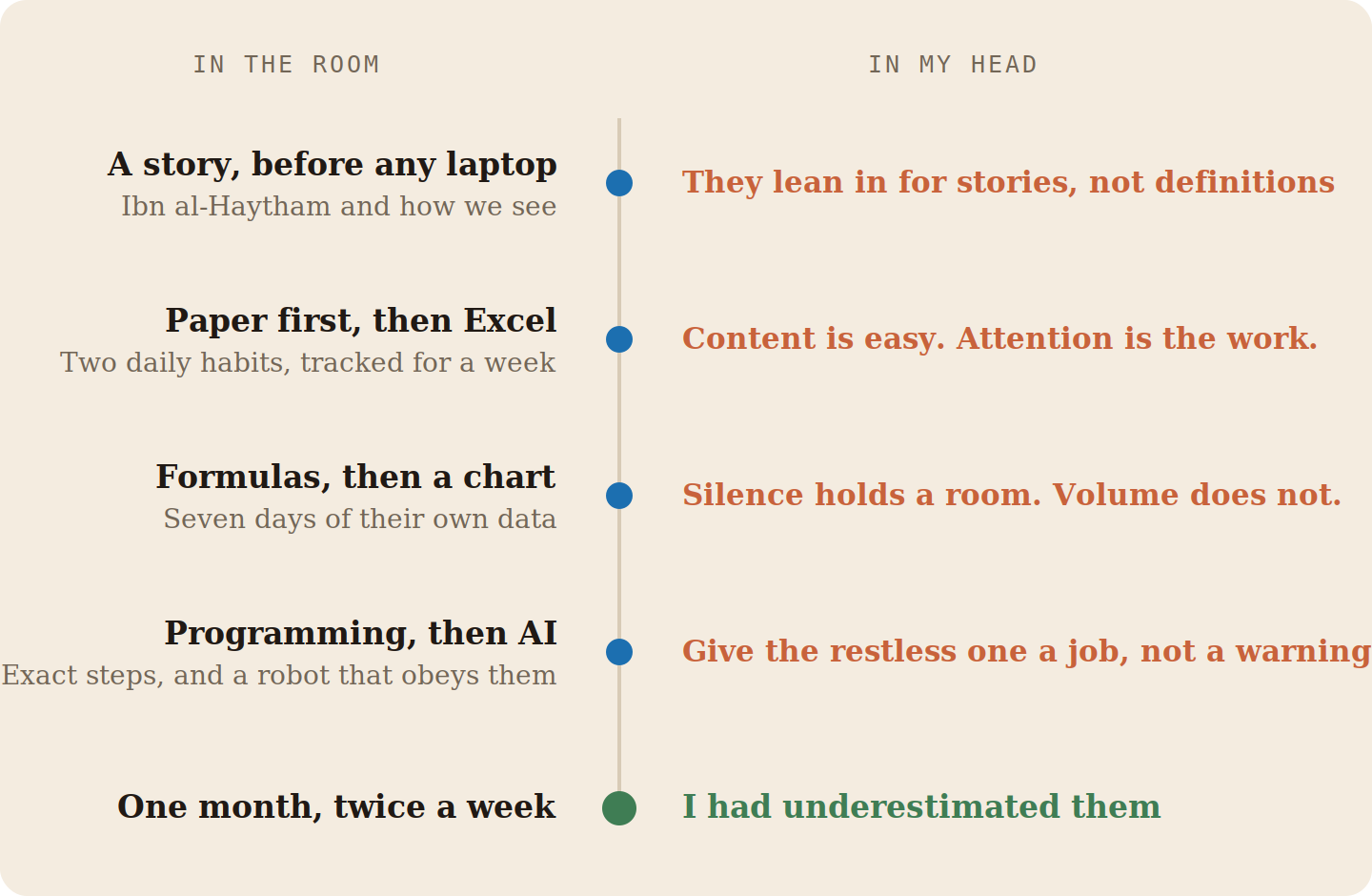
I underestimated them
Here is the part I am almost embarrassed to admit. Midway through the camp, I wondered if what I was teaching was too simple. Basic Excel. Tracking two daily habits for a week, then turning the data into a chart. The concept of programming, taught with paper steps and a small robot app that follows instructions in whatever order you give them. Was this too easy for them?
By the end of the program I knew I had it exactly backwards. The question was never whether the material was too simple for the children. It was whether I had underestimated what children can do.
Some of them confidently answered questions I would ask an adult. When I asked how AI differs from the machine learning behind maps and video recommendations, a few answered that it is generative, that it can create things. They understood it, not as a memorised line but as an idea.
One quiet boy said almost nothing the entire month. Never raised his hand, never asked for help. On the final Excel class I finished explaining the chart activity and walked the room, expecting to help him first. He had already finished. All of it, correctly, in silence.
I had spent weeks managing the loud ones and nearly missed the student who was learning the most.
And on the last day, one boy showed me an app he had built himself using a prompting tool, an education app to help with memorisation. Others had built projects in Scratch. A twelve year old shipped something most working adults do not yet know is possible. I did not know it myself.
Still far from a perfect teacher
I want to be honest about the other side. Managing them was genuinely hard. There were classes where the room got away from me completely, where I went home knowing I had failed at the one thing that mattered that day. I am still far from being a perfect teacher, and even further from a naturally strict one.
But every difficult class taught me something I used in the next one. Silence works better than volume. Rules stated once, calmly, and enforced the first time they are broken. Freedom while they build, full attention while I speak. By the final week, the same room that once ran over me was quiet when it needed to be and loud in the right way the rest of the time.
That progression, more than anything I taught, is what the month gave me. Confidence that I can do this. Proof that the gap between what children can do and what adults assume they can do is much smaller than we think. And a reminder I did not expect to need: teaching is just as much about learning as it is about sharing knowledge.
The camp ended on 22 July. I went to give something to the community. I am fairly sure I received more than I gave.
← Back to Reflections