An offline AI that answers from your own documents
I built a document assistant that runs on a laptop with no internet, answers in English and Arabic, and shows the exact line it used. Here is how, and the one problem that took the longest.
The documents in this demo are fictional and were created for demonstration. They do not belong to any real organisation. The design, the code, and the measurements are real.
A seven minute walkthrough: the machine goes offline, then answers in English and Arabic, refuses a question it cannot answer, and learns a new document on camera.
I built a document assistant, called IlmiChat, that runs entirely on one machine with no internet connection. It answers questions from an organisation’s own documents in English and Arabic, and for every answer it shows you the exact paragraph it used.
On a fixed set of test questions it found the right document 31 times out of 33, gave the correct fact 32 out of 33, and refused correctly on all 36. It runs on my own laptop, which has two cores, 8 GB of memory, and no graphics card.
The problem
A few weeks ago I was reading about Kuwait’s rules on where sensitive data can live, and one question stuck with me. If an organisation is not allowed to send confidential data outside the country, or simply is not comfortable doing it, how does it use AI at all?
ChatGPT, Claude and Gemini all run in the cloud. So the moment you paste a confidential document into one of them, that document has left the building. For a bank, a hospital or a ministry, that is often where the conversation ends.
I showed an early version to a friend who is a chartered accountant, mostly to hear what he would say. He told me his organisation already has ChatGPT Enterprise, and they still are not comfortable putting certain financial data into it. He wanted to know more, and we are still talking. That is when it stopped being a hobby project.
How it works
The whole system runs locally. A small language model does the answering, a second model turns each document into a form the computer can search by meaning, and a local database holds it all. There are no API keys and no external calls, so you can disconnect the machine from the network and it keeps working. That is not a side effect. It is the entire point.
The method is straightforward to describe. Each document is split into small, single-topic pieces. Every piece is stored by its meaning rather than its exact words, so a question about “a patient who missed an appointment” can find a policy that says “failure to attend”. When you ask something, the system pulls the handful of pieces closest in meaning, and the model answers using only those, with the source shown beside the answer.
What it runs on
For anyone who wants to picture the machine rather than take my word for it.
| Component | What I used |
|---|---|
| Answering model | Qwen3 1.7B, served locally through Ollama |
| Embedding model | A multilingual model producing 768 numbers per piece, chosen because it handles Arabic as well as English |
| Database | LanceDB, a local file on disk, no server process |
| Text extraction | poppler, after the Arabic problem described below |
| Backend | Python with FastAPI |
| Interface | A small React page |
| Machine | Intel i3, two cores, 8 GB of memory, no graphics card |
| Pieces retrieved per question | Three |
Response times on that machine, from the figures printed under each answer: finding the sources takes a few seconds, and the first word of the answer appears somewhere between 20 and 60 seconds later, depending on how much memory is free at the time.
That spread is worth being honest about. It is a laptop running a language model, a web server and a browser inside 8 GB, so the numbers move. On a machine with a graphics card the same answers arrive in seconds. The hardware changes the speed, not the answer.
This is also why the sources appear on screen before the answer does. Retrieval finishes early, so the excerpts are there to read while the model is still writing.
Not everyone should see everything
In most organisations the interesting question is not whether an assistant can answer. It is whether it answers the wrong person.
Documents belong to a department: HR, Finance, Operations, IT, or a shared space everyone can see. A member of staff sees only the departments they belong to.
The demonstration is short and it is the part that matters most to a bank. One employee asks for the staff salary bands and gets them, with the source policy shown beside the answer. Another employee asks the identical question and gets a not-found response. Same system, same question, same document sitting on the same server.
Two details make that real rather than cosmetic.
The filter runs inside the database query, not on the results afterwards. Text a user is not allowed to read never enters the model’s context at all. Filtering afterwards looks identical from the outside and is not the same thing, because a small model will happily quote something it was told to ignore.
And the refusal never says “access denied”. It gives the ordinary not-found response, exactly as if the document did not exist. Telling someone they are not permitted to see a file confirms that the file exists, and in an HR context that is itself a leak.
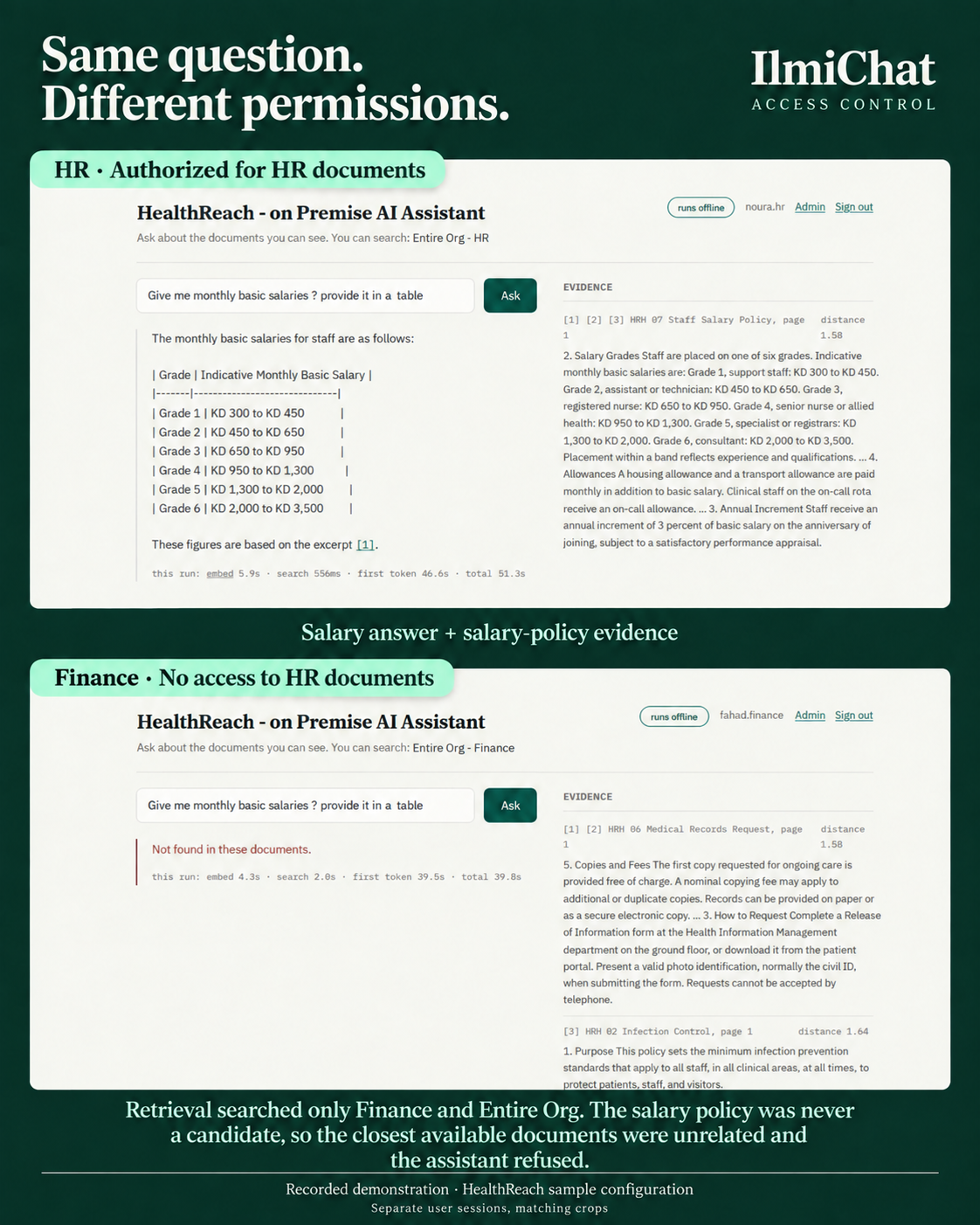
Look at the evidence panel on the second one. Unrelated documents appear there because the search only ever ran across Finance and the shared space. The salary policy was not ranked lower. It was never a candidate.
The hard part was getting it to say “I don’t know”
The demo that impresses people is the one where it answers. The problem that actually mattered was the opposite one.
A model that invents a confident answer is worse than useless when the documents are financial or medical, because the confident wrong answer is the one someone acts on. So I needed it to refuse cleanly when the answer was not in the documents.
At first it refused too often. It would decline questions even when the answer was sitting right there in the text it had retrieved. I had written this down as a limitation of using a small model, and I was close to spending money on a bigger machine to fix it.
Then I measured it properly and found the cause was my own instruction, not the model. I had been forcing it to reproduce a long refusal sentence word for word, which is harder for a small model than simply answering, so under any doubt it took the easy way out and refused. I changed it to reply with a short marker instead, and show the human sentence in its place. Refusal accuracy went to 36 out of 36, and several questions I had blamed on the model started answering correctly.
I had almost bought hardware to fix a wording problem.
Arabic broke in a way my own tests could not see
Arabic was not an afterthought. It was in from the first version, because in Kuwait a system that only works in English solves half the problem.
Getting Arabic text out of a PDF is harder than it looks. Arabic runs right to left, but numbers inside it run left to right, and many PDFs store the text in the order it appears on the page rather than the order you read it. The library I started with misread Arabic lines as left-to-right and reversed them at the wrong level. Words survived. Numbers did not. A time like 09:00 ended up fused to the wrong word and sitting in the wrong sentence.
Here is the part worth remembering. When I fixed it, the retrieval score did not move at all. Not by one question.
The words in each passage were intact and only the numbers had shifted, so the system still found the right document every time and every automatic check I had passed cleanly, before and after. For weeks the dates and times in every Arabic document had been wrong, and nothing in my own tests could see it.
In a policy document, the numbers are the entire point. A dose, a deadline, a percentage. That bug would have produced confident, cited, wrong answers in Arabic and nothing would have flagged it.
The fix was to change how the text is read and then add a check that refuses a document outright rather than indexing broken text.
I measured it, I did not guess
Anyone can show a chatbot answering one question. Almost nobody shows a number for how often it retrieves the right document, or how often the answer contains the correct fact.
So I built a fixed set of 36 questions with known answers, in both languages, including three that cannot be answered from the documents at all. The system is scored against it on three separate things: did it find the right document, did the answer contain the correct fact, and did it refuse exactly when it should. The scores are written to a file with the date and the settings, and the whole test re-runs whenever I change anything, failing loudly if any score drops.
That third check exists because of one specific failure, and it is worth describing.
Asked when the second term ends, the system answered with the end of the academic year instead. It had retrieved the right document, at the top of the list, and cited it correctly. Retrieval scored it a success. The refusal check scored it a success. Two out of three measurements called a wrong date a win.
The cause was in the source text: one passage holding ten dates across three terms, with one date appearing twice in two different roles. A model this small loses the thread across that.
I tried the cheap fix first, because a wording change had already solved the refusal problem without new hardware. It did not work here. So this one is genuinely the model being small, and I know that because I tested the alternative rather than assuming it.
That is the single question it still gets wrong. I would rather publish the real number and explain it than show a perfect score on a test I wrote myself.
What it will not do
Scanned documents are rejected, not indexed.
I tested Arabic character recognition on a deliberately degraded scan, the kind of photocopied circular a ministry archive is full of. It did not return errors. It returned confident nonsense: reference numbers reversed, invented English words sitting inside Arabic sentences, and the figures that carry the actual meaning simply gone.
That is worse than failing, because nothing downstream can tell. The text chunks normally, stores normally, retrieves normally, and gets cited with a page number. So scanned documents are detected and refused at upload until a person can review the recovered text before it is indexed.
I would rather say that plainly than claim support for something I have watched produce fiction.
Built for one thing, pointed at another
The system was built and measured against one set of documents, a fictional school. The demonstration in the video uses a completely different set, a fictional hospital.
Nothing in the code changed between the two. New documents, a new assistant name, new departments, and it worked. That is the claim this project actually makes: not that it knows about schools or hospitals, but that it is the same engine pointed at whichever documents an organisation has, running inside their own building.
What I would tell another builder
Measure before you spend. I was one purchase order away from fixing a prompt with a new computer, and only the number stopped me.
Build the test set before you start improving things. Every change I made after that point was measurable. Everything before it was a feeling.
And the unglamorous parts were the real work. Reading the text cleanly, keeping each piece on one topic, and building the harness mattered more than any clever prompt.
A system that admits when it does not know is worth more than one that always has an answer, especially when the documents are the kind you are not allowed to send to the cloud in the first place.
If your organisation has documents it cannot put into a cloud AI, this is the direction I would look, and I am happy to talk about how it works.
← Back to Projects